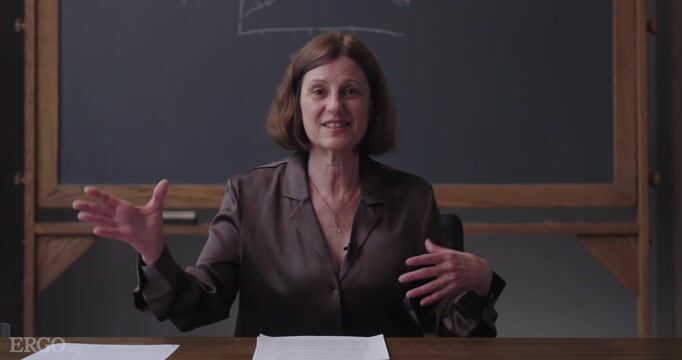
Personal Identity and Narrative
Marya Schechtman begins with a question fundamental to personal identity: what makes you the same person over time? We effortlessly recognize friends, hold people responsible for their past actions, and plan for our own futures, all of which depend on the assumption that people persist as the same individuals through change. But what grounds that assumption? This course takes up that question and follows it through the major philosophical answers that have been proposed.
The opening lectures introduce the problem through classic puzzles like the Ship of Theseus, which asks whether an object that has had every part replaced is still the same object. From there, Schechtman turns to the two dominant theories of personal identity. The psychological continuity theory, rooted in John Locke's idea that memory and consciousness are what make you you, holds that identity follows the mind rather than the body. The biological or bodily continuity theory counters that you are fundamentally a living organism, and your identity is tied to the persistence of that organism regardless of what you remember or how your personality changes.
Each theory is tested against vivid thought experiments: teleportation cases, brain transplants, fission scenarios in which a single person seems to become two. These cases, many of them drawn from Derek Parfit's influential work Reasons and Persons, reveal deep tensions within each approach. The psychological theory struggles with cases where continuity branches or seems too shallow to capture what we truly care about. The biological theory faces the challenge of explaining why identity should be defined independently of everything that seems to matter to us as persons.
With these difficulties in view, Schechtman introduces a third option: the narrative approach to personal identity, which she has developed in her own philosophical work. On this view, what unifies a person over time is not a single psychological connection or a biological fact but the ongoing, evolving story a person tells about who they are. Our identities are constituted by the narratives we construct and live by. It's these narratives that weave together our memories, intentions, values, and relationships into a coherent life.
The final lecture confronts the sharpest objection to this approach: that life is not a story, and treating it as one confuses fiction with fact. Schechtman responds by clarifying what the narrative view actually requires. It does not demand that we author our lives like novelists. It asks instead that we maintain a basic, self-aware understanding of how our experiences connect over time. Such an understanding is shaped and constrained by the real world and by the people around us. The course closes by suggesting that the two senses of identity we began with (the metaphysical question of whether a self persists over time and the personal question of who you really are) may be more deeply connected than philosophers have traditionally assumed. No prior background in philosophy is needed to follow these lectures.

Marya Schechtman
Marya Schechtman is Professor and Chair of Philosophy and a member of the Laboratory of Integrative Neuroscience at the University of Illinois Chicago. Her research focuses on personal identity, memory, and the self. Her work emphasizes the connections among metaphysical, empirical, and ethical questions of identity and narrative dimensions of the self. She is the author of The Constitution of Selves (Cornell University Press 1996), Staying Alive: Personal Identity, Practical Concerns and the Unity of a Life (Oxford University Press 2014), and The Self a Very Short Introduction (Oxford University Press 2024), as well as numerous papers and articles on self, identity, memory, and mind.